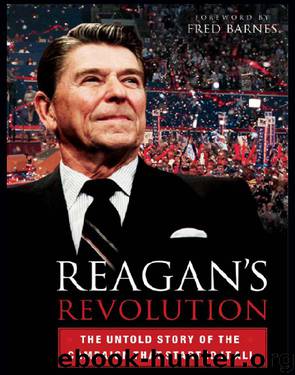
Reagan's Revolution by Craig Shirley
Author:Craig Shirley
Language: eng
Format: epub
Tags: ebook, book
Publisher: Thomas Nelson
Published: 0101-01-01T00:00:00+00:00
10
FORD STORMS BACK
“That damned Stu Spencer!”
As the new leader for the Republican Presidential nomination, Ronald Reagan now looked to press the advantage over his wounded opponent. Campaigning in Idaho before heading to Ford’s adopted home state of Michigan, Reagan told a crowd, “With Jimmy Carter the possible, or even probable, Democratic nominee, Republicans are faced with some important questions. Will we, as a party, be offering new solutions to old problems or defending old policies against the attacks of a Democrat who is not part of the Washington establishment?” Reagan continued, “The results of the last several primaries—in both parties—reveal a great desire on the part of the people for a change, an end to politics as usual.”1
Looking down the road, Reagan told conservatives and the media that it was he, and not Ford, who could successfully challenge Carter in the South in the fall campaign. He said of his eventual choice for a Vice Presidential candidate that he would, “look to the same Republican mainstream for a running mate whose principles are strong and whose practices are sensible.”2
Media coverage in the weeks leading up to the May 18 Michigan primary included apocalyptic phrases like “crucial,” “critical,” “embarrassment,” “vital,” “embattled” and “last chance,” when describing Ford’s campaign in his home state primary, which would be held two weeks after his disastrous triple loss to Reagan in Indiana, Georgia and Alabama.
The New York Times editorialized, “A second unfavorable omen for Mr. Ford is the geographic location of most of the remaining primaries. The Northeast and the industrialized Middle West, the two regions where the President is strongest, have already chosen most of their delegates.” Besides Michigan, only primaries in Ohio, New Jersey and Rhode Island remained. “Otherwise, the candidates fight it out in a dozen Southern, border, and Western states where Mr. Reagan can be expected to do well.”3
The Reagan campaign weighed a more aggressive effort in Michigan, since it, like Texas, provided for crossover voting. In 1972, hundreds of thousands of Republicans had crossed over to join the other 800,000 who voted in the Democratic primary for George Wallace, helping him win.4Now there was a very real threat to Ford that the same might happen in reverse, to Reagan’s benefit. As always, however, money was a major problem for the Reagan campaign.
Adding to Ford’s worries was the fact that Wallace had nearly disappeared from the field and, in Michigan as in Texas, his supporters could be cut adrift to potentially land on Reagan’s shore. Wallace’s political support was fading before the new, ascending son of the South, Jimmy Carter. Wallace would be on the ballot in Michigan but would be doing little active campaigning.
The New York Times took a look at the “typical” Wallace/Reagan voters and, in turn at cultural stereotyping, described them as, “nursing their frustrations about government giveaways, welfare cheaters, featherbedding bureaucrats who loaf, and politicians who are tax-squeezing the middle class to pay for social programs that do not work.” A sociologist told the Times they were, “middle class radicals.
Download
This site does not store any files on its server. We only index and link to content provided by other sites. Please contact the content providers to delete copyright contents if any and email us, we'll remove relevant links or contents immediately.
| Anthropology | Archaeology |
| Philosophy | Politics & Government |
| Social Sciences | Sociology |
| Women's Studies |
The Secret History by Donna Tartt(19291)
The Social Justice Warrior Handbook by Lisa De Pasquale(12222)
Thirteen Reasons Why by Jay Asher(8992)
This Is How You Lose Her by Junot Diaz(6954)
Weapons of Math Destruction by Cathy O'Neil(6362)
Zero to One by Peter Thiel(5863)
Beartown by Fredrik Backman(5835)
The Myth of the Strong Leader by Archie Brown(5550)
The Fire Next Time by James Baldwin(5501)
How Democracies Die by Steven Levitsky & Daniel Ziblatt(5271)
Promise Me, Dad by Joe Biden(5189)
Stone's Rules by Roger Stone(5128)
A Higher Loyalty: Truth, Lies, and Leadership by James Comey(5017)
100 Deadly Skills by Clint Emerson(4968)
Rise and Kill First by Ronen Bergman(4833)
Secrecy World by Jake Bernstein(4794)
The David Icke Guide to the Global Conspiracy (and how to end it) by David Icke(4770)
The Farm by Tom Rob Smith(4545)
The Doomsday Machine by Daniel Ellsberg(4538)
